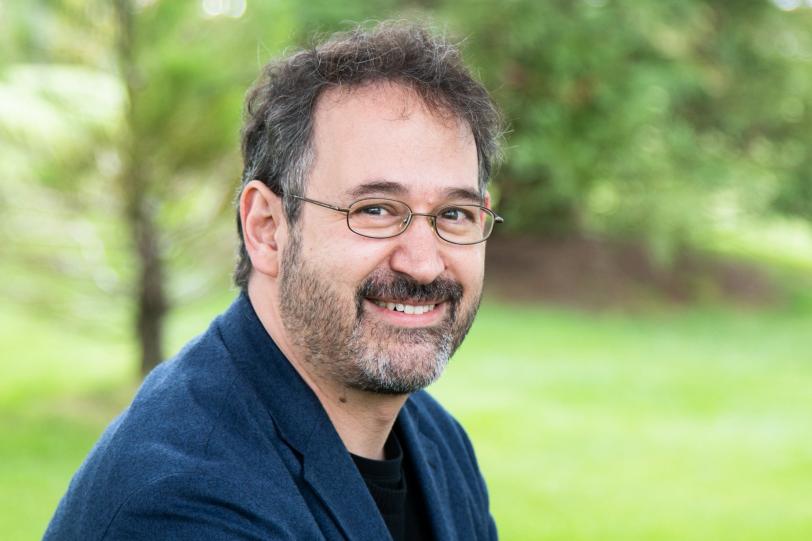
David Reis named head of PULSE Institute for ultrafast science
He helped lay the groundwork for SLAC’s LCLS X-ray laser and for the institute, which was founded to explore the science LCLS would enable.
By Glennda Chui
Long before David Reis joined the faculty of the Department of Energy’s SLAC National Accelerator Laboratory and Stanford University, he was helping lay the groundwork for the lab’s first-of-a-kind X-ray free-electron laser, or XFEL, and the revolutionary science that followed its opening in 2009.
Now he’s director of the PULSE Institute, which was founded by SLAC and Stanford with the express purpose of exploiting the possibilities for ultrafast science at that X-ray laser, the Linac Coherent Light Source (LCLS). It was the first XFEL in the world with pulses energetic enough to image matter at the atomic scale, with beams a billion times brighter than any available before.
Founded in 2005 with Stanford/SLAC Professor Phil Bucksbaum as director, PULSE has seen steady growth over the past decade. Today it has an annual research budget of more than $18 million and a roster of 145 members, including faculty, staff scientists, graduate students and postdoctoral researchers, working in a richly collaborative environment. PULSE scientists have led many of the key research achievements of LCLS over the past decade and are helping to chart a path forward and beyond LCLS.
“This is a critical juncture for PULSE as the lab prepares for LCLS-II, which will create opportunities for ultrafast science we can’t even imagine yet,” says SLAC Director Chi-Chang Kao. “I want to thank outgoing Director Phil Bucksbaum for his vision and leadership of PULSE over the past 12 years, and thank David for stepping up to move us forward.”
The ultrafast mission
LCLS was just a dream when Reis first started coming to SLAC as a University of Rochester graduate student in the mid-1990s to work on an electron gun for a prototype LCLS injector. There were so many obstacles, and so much skepticism about whether it would work, that “at the time I didn’t think they’d ever build LCLS,” he confesses.
But the lab and its partners persisted, and one sign of their success is that SLAC now considers ultrafast science a key part of its mission, Reis says. This branch of research uses beams of X-rays and electrons to explore the worlds of atoms and molecules on their natural timescales of femtoseconds – millionths of a billionth of a second – and it’s on the cusp of routinely exploring electron behavior at the attosecond scale of billionths of a billionth of a second.
Originally from Buffalo, NY, Reis grew up outside Dallas, got his bachelor’s degree in physics from the University of California, Berkeley in 1993 and earned master’s and doctoral degrees in physics from the University of Rochester. He did postdoctoral research at the Center for Ultrafast Optical Science at the University of Michigan and joined the faculty there in 2001.
While at Michigan, he took a sabbatical to collaborate on a project that helped set the stage for LCLS: the Sub-Picosecond Pulse Source (SPPS). Based at the SLAC linear accelerator, it created the world’s shortest bunches of electrons and sent them on a wiggly path through an undulator to generate ultrafast pulses of X-ray light.
About 50 researchers from 10 institutions used those X-ray pulses for experiments that explored how atoms move in a rapidly melting solid, how to precisely clock the instant when a laser or X-ray beam hits a sample under study and other issues of interest to future LCLS experimenters.
Reis also helped with the proposal that led to the establishment of PULSE as a Stanford independent research institute run jointly with SLAC. In 2009, the year LCLS saw first light, Reis came to SLAC and Stanford as an associate professor and deputy director of PULSE. He became a full professor last year and assumed the directorship of PULSE in January 2019.
“I knew I wanted to come use LCLS when it was ready,” Reis says. “I was taken by two ideas – one, that you could make molecular movies, and the other that you could use laser pulses to shape the outcome of a chemical reaction. But I ended up going in a different direction.”
Along with fellow Michigan scientists Mariano Trigo and Shambhu Ghimire and graduate student Jian Chen, who moved to SLAC at the same time, Reis has made use of LCLS to study how energy spreads and dissipates in materials that are excited with light, as well as continuing to explore a phenomenon called high-harmonic generation in solids that they had previously discovered with colleagues at the Ohio State University.
Building on synergies
Reis says his top priority is to continue PULSE’s culture of providing a stimulating, welcoming and multidisciplinary home for ultrafast science-enabled research at Stanford and SLAC. To this end, he thinks it will be critical to strengthen PULSE’s numerous connections to other research organizations, including LCLS and the Stanford Institute for Materials and Energy Sciences (SIMES), and says he would like to see PULSE grow in terms of staff, faculty and students.
“I'm very happy that David has taken this on because of his experience, deep interest and well-deserved international recognition in the field of ultrafast X-ray science,” Bucksbaum says. “I look forward to a great future for PULSE.”
For questions or comments, contact the SLAC Office of Communications at communications@slac.stanford.edu.
SLAC is a multi-program laboratory exploring frontier questions in photon science, astrophysics, particle physics and accelerator research. Located in Menlo Park, Calif., SLAC is operated by Stanford University for the U.S. Department of Energy's Office of Science.
SLAC National Accelerator Laboratory is supported by the Office of Science of the U.S. Department of Energy. The Office of Science is the single largest supporter of basic research in the physical sciences in the United States, and is working to address some of the most pressing challenges of our time.
Related stories